
How our bibs keep you dry(er) and the surface level science behind it. This is a dense topic, so for the sake of brevity, we do not go into some of the finer details.
This feels long overdue. Ahead of our launch this winter, we wanted to give you a what’s up with how our product works and how it differs from the materials and systems you traditionally use.
First, a caveat. WE ARE NICHE. Our product was built for a specific purpose: low aerobic activity in wet and warmer conditions. For example, a full day riding chairlifts in wet snow, sleet, or rainy conditions that we find here in the PNW.
Membrane technologies or 3L fabrics, which are used in the majority of ski pants and bibs, are valuable, even here in the PNW, and nothing below intends to discredit them. We fully support a well rounded arsenal for different conditions and activity levels. We believe there is a time and place for this technology.
But here, we’ll explain our perspective and why we took a different route.
All about membranes
Membrane technology is a sandwich of fabrics and components glued together with a thin “waterproof” film at its center. Nearly all ski and snowboard outwear is constructed using this material. It is reasonably effective in a wide spectrum of conditions, and can be used for a variety of output levels and activities, including, often, more urban environments. But that versatility can be a shortcoming in highly demanding specific conditions, think wet, like we experience in the PNW. For our product, this versatility is why we still use membrane technology in areas that don’t experience as much water pressure like your upper hip zone and lower legs. What sets us apart is using a fully waterproof and non breathable fabric in higher exposure locations.
Membrane composition
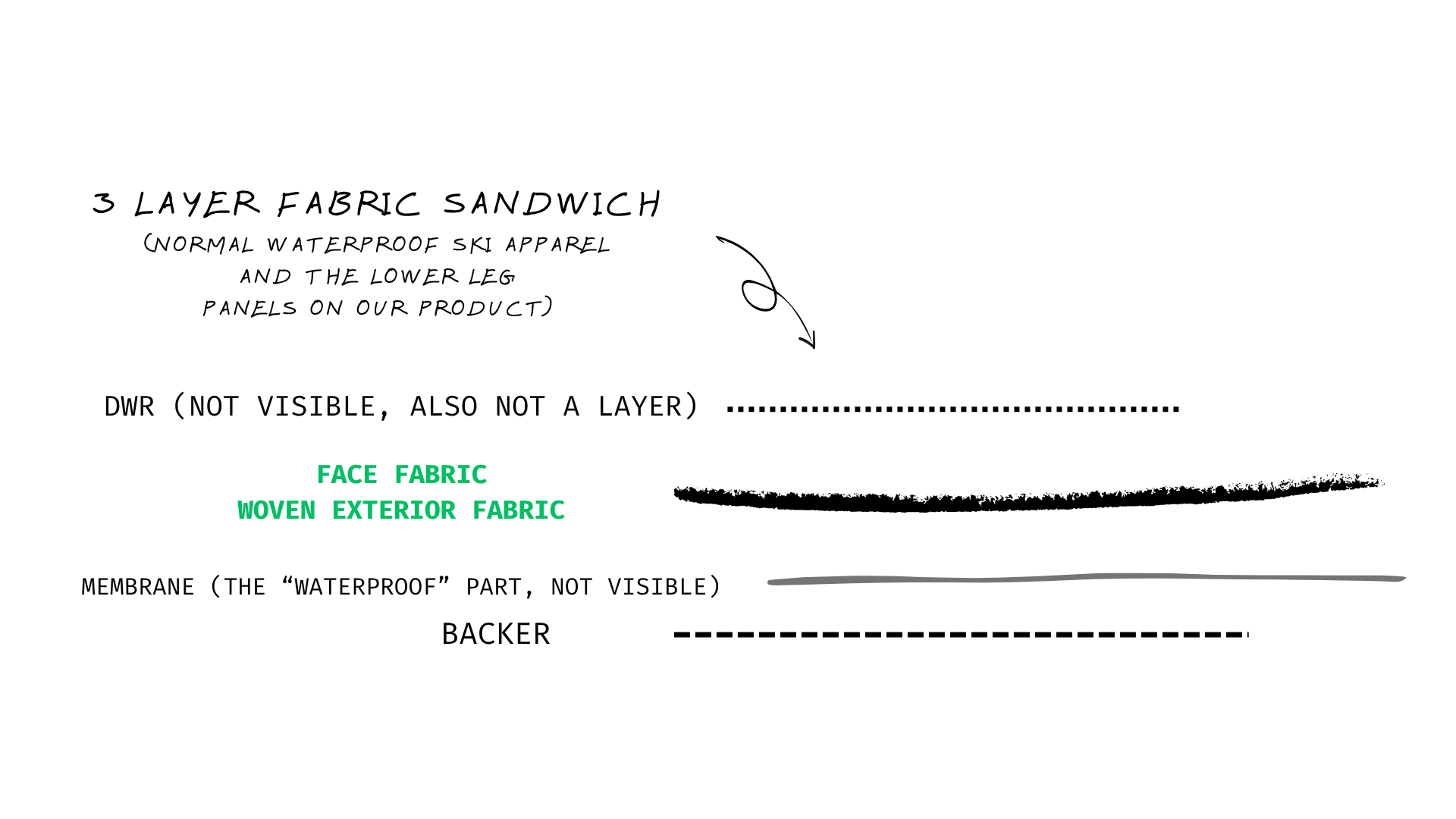
The membrane itself is effectively a thin film of stretched plastic that provides the waterproofing. Alone, it is not very durable. It can rip and wear down easily, and contamination from body oils and sweat residue can compromise it. So it gets sandwiched between a face fabric and a backer. The most common build is called three layer (3L), which consists of a woven layer, a membrane, and a backer, typically glued together to make a laminate. Less expensive ski apparel will opt for a two (2L) or two and a half layer (2.5L) fabric, which saves money by removing the backer.
How membranes work
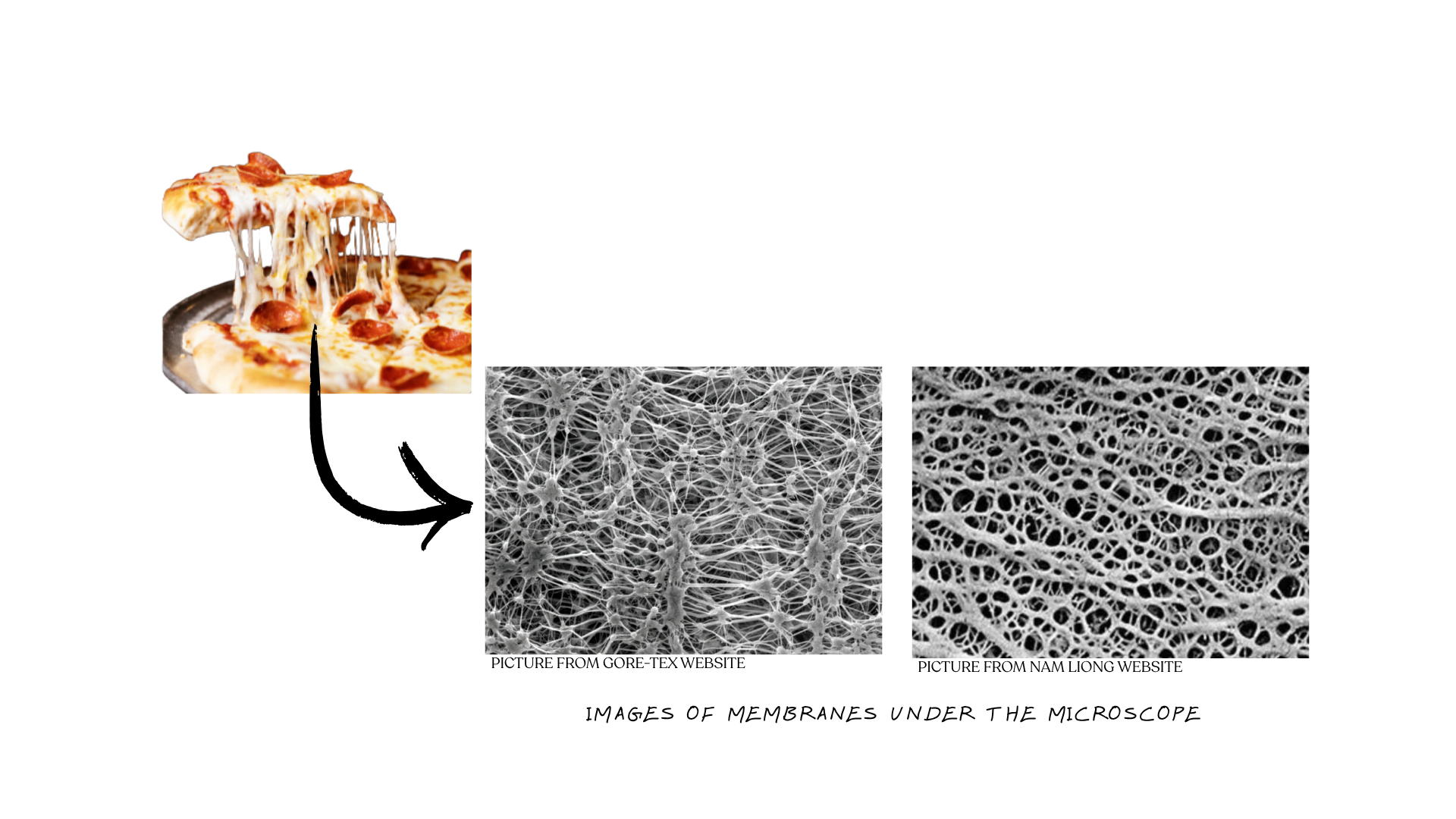
Many (most ish) membranes are microporous which means the plastic is stretched, and the act of stretching creates microscopic pores. Much like the effect of pulling on a slice of cheese pizza. The pores are the gaps between the stretched strands. If you want the nitty gritty of how ePTFE membranes are made, this link does a good job.
These pores are smaller than liquid water droplets (e.g., rain) but larger than water vapor molecules (e.g., evaporated sweat). (A few membranes skip pores entirely and move vapor by absorbing it and passing it through the membrane.)
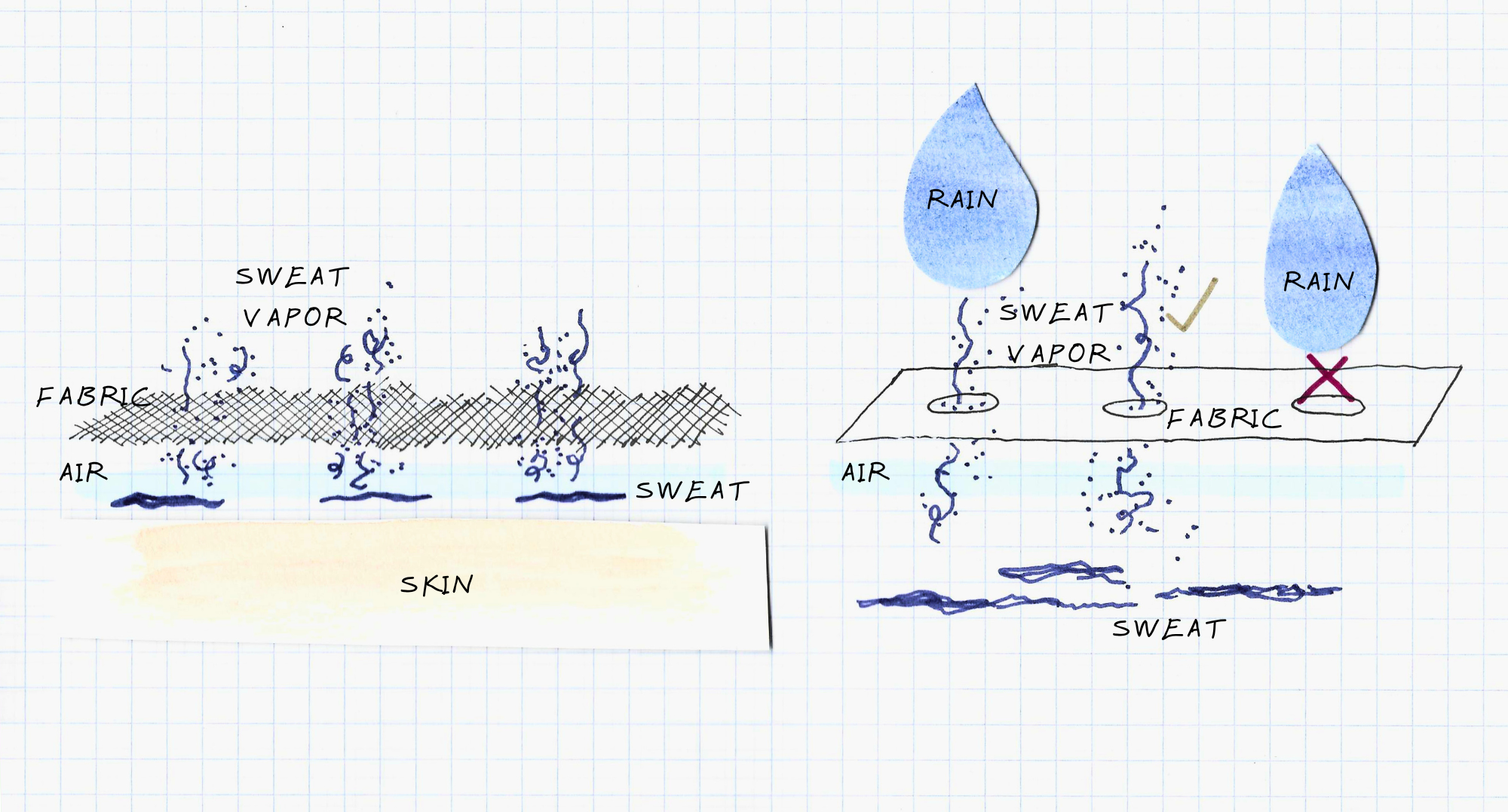
That's what "breathable" means: your sweat evaporates and the vapor escapes through the pores (or passes through the membrane). Membranes are considered the gold standard because they can be both waterproof AND breathable. Breathability matters because we sweat and generate heat, at rest and especially when active. The harder you work, the more it matters.
Wetting out vs. getting wet
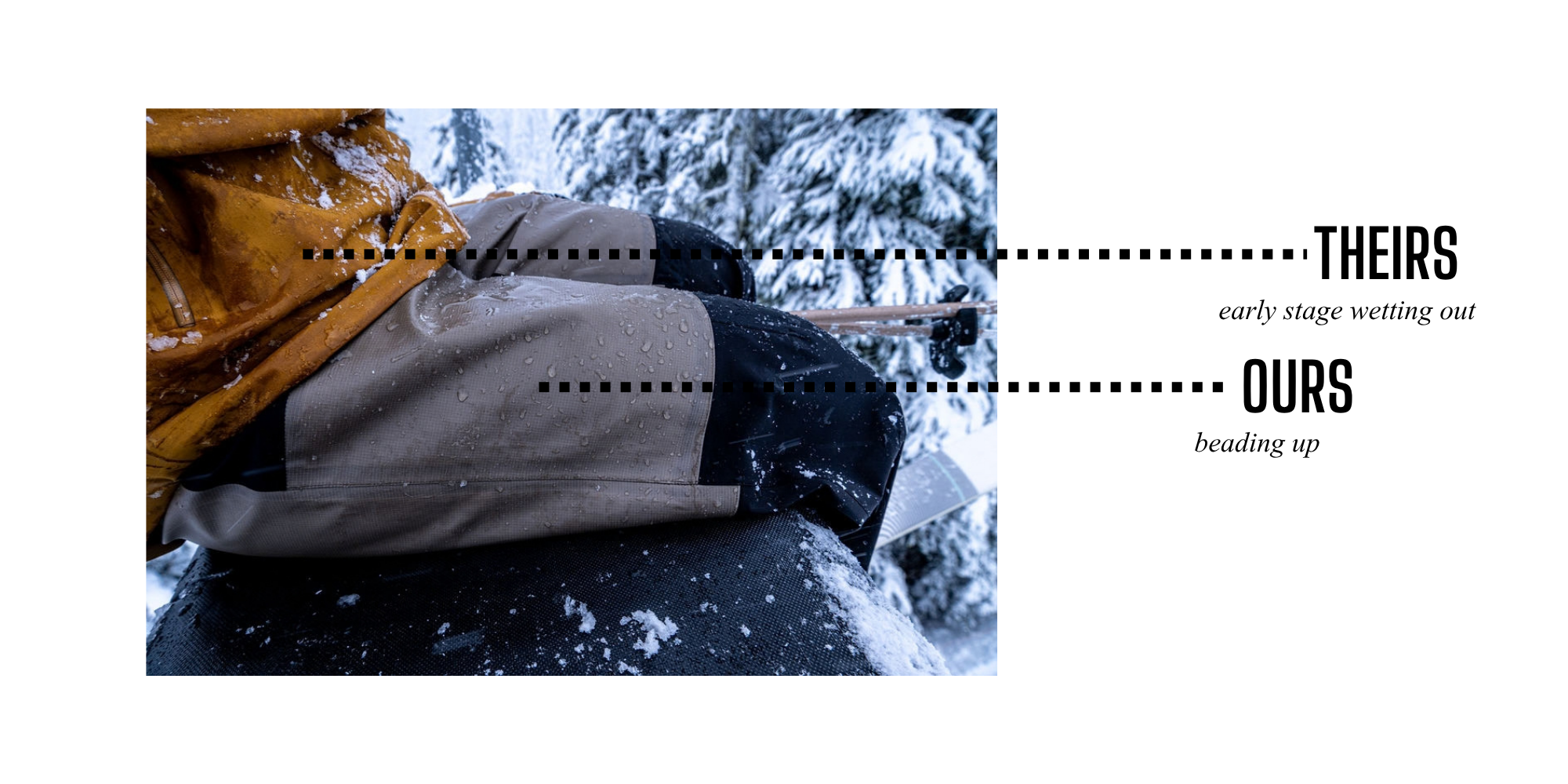
Face fabric absorption is called wetting out. It isn’t the same as getting wet, though wetting out often feels identical. There are several reasons for this:
We don't have hygroreceptors — dedicated "wet" sensors that some other creatures like insects and anarchids have. Instead, the theory goes, our brain infers wet from touch and temperature. One cold-sensing channel in our skin may pull double duty, flagging both cold and wet.
Water conducts heat better than air. Which means your body heat travels through water faster than air. We have reason to believe that when fabric is wet from wetting out, heat moves away from your body faster than if it were coated fabric and air - i.e., it’s harder to stay warm when your gear is wet!
It’s heavy. A saturated fabric weighs more because you are accounting for both weather and the fabric itself.
Membrane shortcomings
Waterproof ratings don’t consider realistic time frames. “Waterproofness” is measured by water pressure as applied by a hydrostatic head in millimeters of water. A 20k rating means water pushes through at 20,000 mm of column, about 28 psi. The video here demonstrates this method. This testing concept has been adapted by the lab community, but we won’t get into that. The test ramps water pressure on one face until water is visible, then records that number. It’s a short pressure ramp, maybe a couple of minutes. It's not a day on the lift, considering time, surface area, and fabric condition. Given more time, water is more likely to penetrate a surface. The video above talks about several shortcomings of this test. The impact of time on penetration comes in at the 3:55 minute marker.
Waterproof ratings don't tell you what you think. The nature of the scale discussed above concedes that every fabric leaks at some pressure. The term waterproof is ironically very fluid. You'll hear 1,500 mm cited as the bar for "waterproof." That's a convention in some markets, not a universal standard, and it works out to about 2 psi, which is a fairly low bar. Some standards are careful about their own language. One common standard, ISO 811, describes a method for fabrics "intended to be water resistant," and it never claims to certify anything as waterproof.
The topic of waterproof testing is dense. The above points briefly address two issues relevant to our product. We’ll likely come back to this topic.
Moisture management is overrated in certain contexts. On a chairlift day you produce a little output on the way down and spend far more time sitting. That reduces the need for breathability. We believe wetting out actually makes things worse: it creates a highly conductive surface that pulls away the little heat you produce. With a less conductive fabric that doesn't wet out, the heat your body makes at rest does more good than harm. In colder environments, even a non saturated surface might be cold enough to act like a saturated surface and draw your heat energy away in order to create balance. This reasoning comes from our field testing and basic heat-transfer physics, not lab data, we're working on measurements.
Durable water repellent (DWR)
DWR is arguably the most important component of a membrane garment. It stands for durable water repellent which is a chemical finish applied to the face fabric. As seen in this video below, water wants to adhere to fabric. But if you break up the fabric surface with DWR, water ignores the fabric and stays together.
Cohesion and adhesion | Middle school chemistry | Khan Academy
Membranes lean hard on DWR. DWR exists to protect the face fabric, and without it a membrane garment loses most of its advantages:
1. Maintains breathability. A soaked face fabric chokes vapor transport. General wear and dirt and sweat residue wear out your DWR, leaving your face fabric susceptible to wetting out. A wet membrane garment behaves much like our non-breathable fabric, but worse, as discussed above. DWR (Durable Water Repellency): Explained & Demonstrated
2. Keeps you warmer. Saturating fabric impacts heat conductivity and evaporation and moves cold water toward your skin as we discussed above in the wetting out vs getting wet section.
Here's our theory, and the jury is still out: DWR protects from water penetration by keeping water away from the membrane. While not widely discussed, we would argue this is why brands are really emphasizing DWR maintenance. And why DWR exists in the first place.
Unfortunately, over time, we have learned that DWR was releasing persistent “forever chemicals” (PFAS) into the environment due to the fluorinated compounds that made it so effective at shedding water, which don’t break down and build up in water, wildlife, and people. And so the history of DWR is one of diminishing returns.
For years the standard DWR was fluorochemical (PFAS), starting with C8. We moved to C6, and now we are onto C0, the last being completely fluorochemical free. They have gotten progressively better for the environment and our health, but significantly worse at staying on your jacket. This is not necessarily a bad thing, we just need to adapt, educate, and find new solutions.
In places like the PNW, where moisture build up is significant and the importance of water beading is heightened, we believe finding new solutions is the way forward.
Our system / A different way
For Fall 2026, we used a quick dry, woven polyester base fabric with an waterborne ether polyurethane (WPU) coating from Polycore Solutions. The application of our coating uses a specialized roller-coating machine that presses the PU deep into the base fibers, making it an integrated part of the fabric rather than just a layer on top. This method improves abrasion resistance, hydrostatic resistance, tear strength, and delamination resistance. Whereas, typical PU coating is done with a knife coating machine.
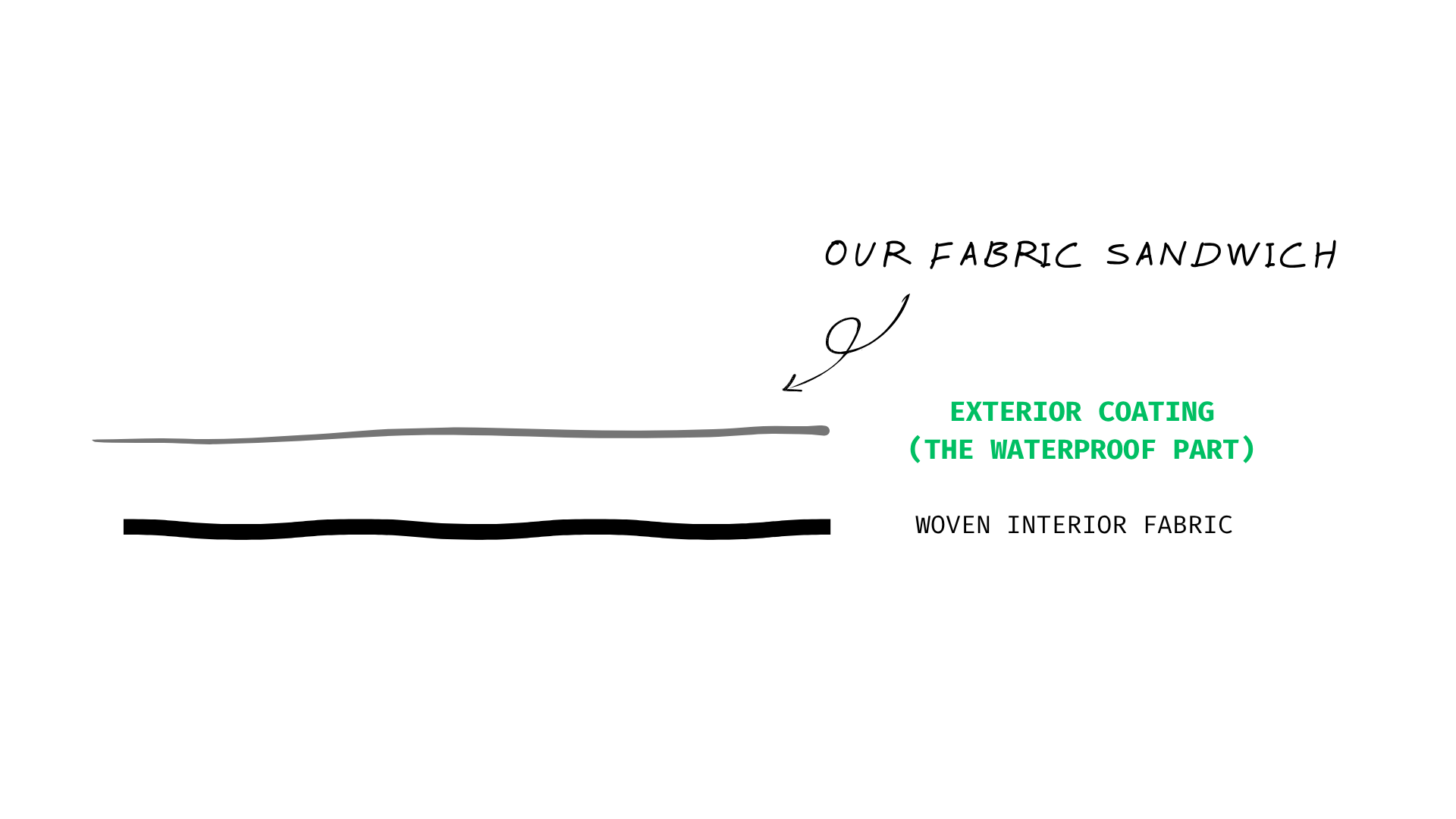
asds
We tape all seams that are exposed to water, as do garments using membrane technology. This can be the area most susceptible to leakage.
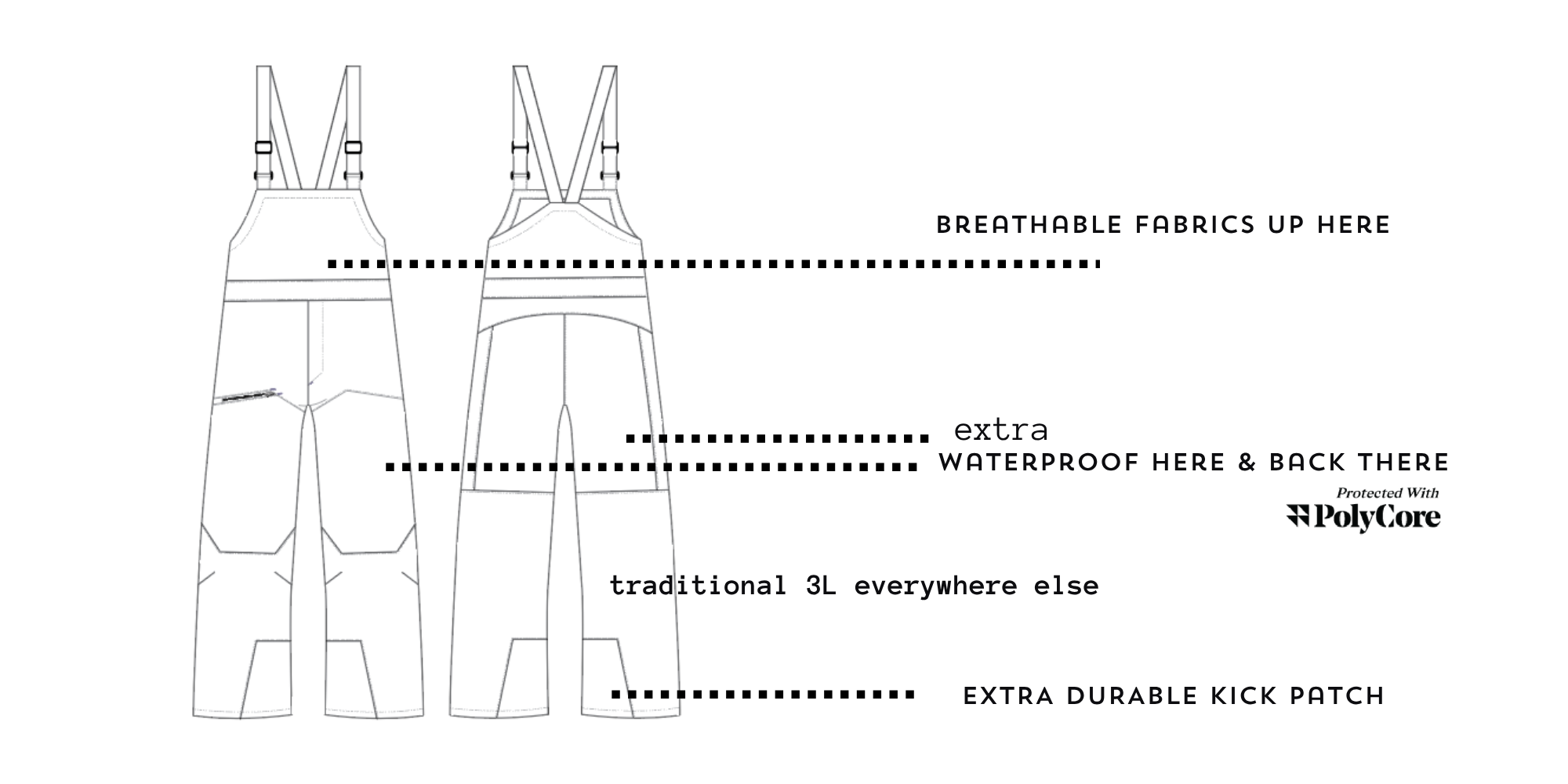
We don't use the coated fabric everywhere. Our garments are a hybrid. Below outlines components found in our Fall 2026 product:
Butt and thighs: WPU sits on the face of the fabric, where you experience the most pressure and water exposure.
Lower legs: 3L fabric
Chest panel: unlayered softshell paneling at the chest panel heightens breathability, where you aren't exposed to the wet. Many bibs use taffeta, mesh and other fabric in these areas, which inhibits breathability.
One large vent on the side.
xxx
What this means for you, dear PNW skier/snowboarder
No wetting out. We don’t use face fabrics in high pressure areas. We have a coating on the outside, which does not absorb water in the same way a face fabric does. In our field testing, the coated fabric with a woven on the inside was more comfortable and managed sweat and external water better than the 3L garments we tried.
We don’t rely on DWR. Less maintenance, more reliability. Using a WPU eliminates the need for DWR, which reduces chemical shedding and prioritizes sustainability without compromising performance. The waterborne nature of the coating replaces harmful solvent-based textile coatings that are used in traditional PU coatings. You can read more about it here.
No pores. Our fabrics do not have the same porous structure as membranes, which limits the avenues by which water can get in.
Moisture management. The coated panels aren't meaningfully breathable, so we manage moisture elsewhere. We use 3L fabric on the lower legs and softshell on the chest, and there's a large vent on one side to help dump heat. Strategically selected base fabrics that absorb sweat and dry quickly help prevent the clammy feeling experienced with 3L fabrics.
Balance outside moisture to inside moisture. Our theory comes down to which is more pronounced: moisture from the weather, or moisture from your sweat.
Minimal seams. One of the things we do is reduce seam lines to help mitigate susceptibility to leakage at these weak points. Two PSI is often used as the standard for seams, which as we talk about above as being not that waterproof by PNW standards.
Our future and current fabric projects
We aim to spend the next couple of years substantiating (or debunking) these claims, finding new ones and exploring new solutions. What we do know is that we are happier in our product. The why will continue to evolve.
For now, our claims rest on field testing and YouTube physics. Our goal for continuous improvement will push us to learn from objective user data, targeted lab tests, subjective real life experiences, and constantly trying new fabrics.
Lab tests are new territory for us, and we’re approaching them carefully. They often lack comparable parameters and the data can be subjective, but we see their value as long as the caveats are transparent and methods are consistent with experiences in the wild. More importantly, we vow to keep being users. There is no substitute for real-life testing, and it will always be our benchmark for performance. We’re working to make our testing more defined and targeted by experimenting with different locations, temperatures, methods, and by collecting more objective data from both our experiences and future lab tests.
We aim to bring you something better rather than settle for the status quo.